
READ
From the Artistic Director: Eureka Day
Dear Friends,
Welcome to Seattle Rep and our production of Eureka Day by Jonathan Spector. This 2025 Tony Award winner has quickly become one of the most-produced plays in the country following its acclaimed Broadway run.
Set mostly during a series of parent-led Executive Committee meetings at a progressive private elementary school, Eureka Day explores some fundamental questions about how we live together: What do we owe one another? How do we solve problems and make decisions when individual convictions collide with the needs of a community? And what happens when consensus is no longer possible?

Sara Hennessy and Nemuna Ceesay in rehearsals for Eureka Day (2026) at Seattle Rep. Photo by Sayed Alamy.
The members of the Eureka Day School Executive Committee proudly hold inclusion, respect for one another, and consensus as deeply shared values. They don’t even vote. They must all agree to move forward. But when a public health crisis affecting their children forces them to make urgent and consequential decisions, those values are put to the test. For Seattle audiences, there may be something particularly recognizable about all this. There is a name for our local tradition of extensive deliberation and consensus-building: the “Seattle process,” a phrase still invoked regularly in our civic life.
Importantly, while the circumstances of the story may feel uncomfortably familiar after the early 2020s, Eureka Day is not a pandemic play. It premiered in 2018. Now, six years after 2020, the play gives us an opportunity to look back at ourselves in that extraordinary moment, recognize some of our behavior, and laugh. Have we changed? Are we any better at listening to one another, navigating disagreement, or balancing individual conviction with collective responsibility? Did we figure out Zoom meetings, at the very least?
Quinn Mattfield, Jonathan Slavin, and Sara Hennessy in rehearsals for Eureka Day (2026) at Seattle Rep. Photo by Sayed Alamy.
The stakes for these characters are high, which makes Spector’s use of comedy all the more effective. His purpose is not mockery. In a note accompanying the play, he cautions against playing these Eureka Day School leaders as caricatures. They are charming, intelligent people, deeply committed to living thoughtful and intentional lives. He asks instead for what he calls the “humor of recognition.” We see ourselves in them: in Don’s determination to keep everyone comfortable, Suzanne’s fierce convictions, Carina’s questioning of assumptions, Meiko’s effort to navigate competing loyalties, and Eli’s well-intentioned certainty.
We laugh because we recognize ourselves in their contradictions, good intentions, and frustrations. That act of recognition has always been at the center of the theater experience: seeing something true about ourselves played out on stage, and leaving with something to reflect on. Eureka Day doesn’t offer easy answers. Instead, it asks something more fundamental: when a challenge arrives, how do we face it together?

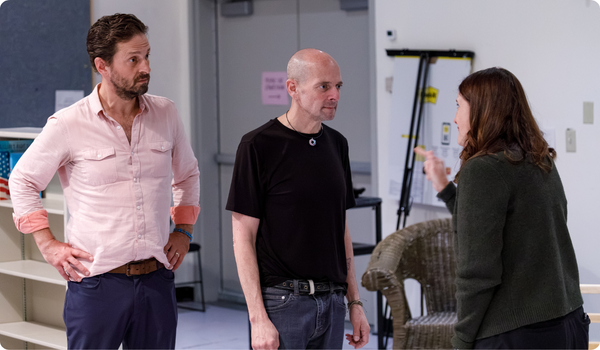
Director Matthew Leavitt and actors Quinn Mattfeld and Sara Hennessy in rehearsals for Eureka Day (2026) at Seattle Rep. Photo by Sayed Alamy.
Our goal is simpler: to share an evening of theater together. I do believe I can speak for all of us at Seattle Rep when I say that we hope you enjoy the play, and that it sparks conversation in the lobby and beyond.
Until next time,
Dámaso Rodríguez
Seattle Rep Artistic Director
Experience this Tony Award winner for yourself—see Eureka Day at Seattle Rep September 24–November 15, 2026.


